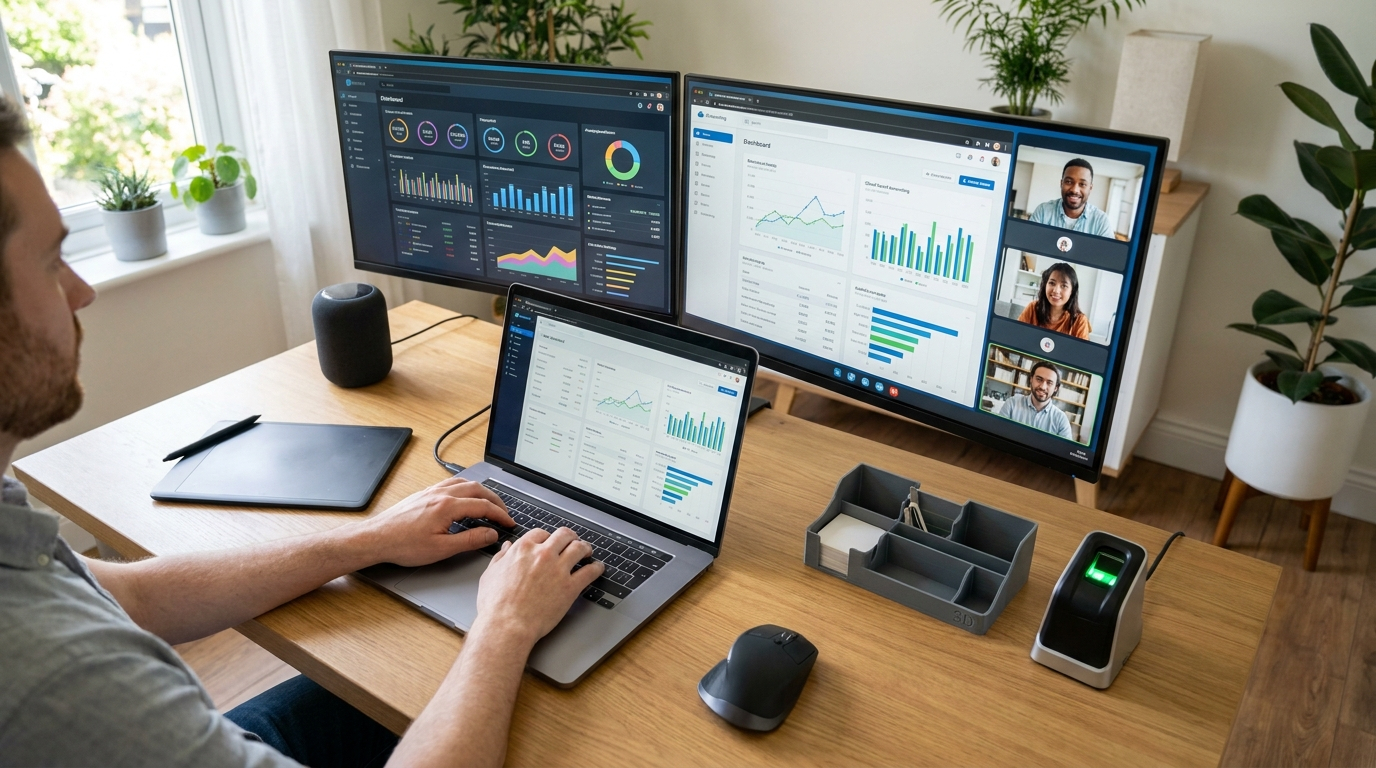
Bookkeeping affects more than tax preparation. It helps business owners understand cash flow, track expenses, manage payments, and make decisions using accurate financial information.
The bigger question is who should handle the work.
Some businesses hire an employee to manage bookkeeping internally. Others work with a remote professional or bookkeeping service. Both options can keep financial records organized, but they differ in cost, flexibility, communication, and day-to-day involvement.
The decision between in-house vs remote bookkeeping is not about finding one model that works for every business. It is about choosing the setup that matches your workload, budget, systems, and plans for growth.
A clear bookkeeping comparison can help you understand how each option works and what you should consider before making a decision.
What Is In-House Bookkeeping?
In-house bookkeeping means hiring someone directly as part of your company.
The employee may work from your office or as a remote member of your internal team, but they are employed and managed by your business. Their main responsibility is keeping your financial records complete and accurate.
Because they work closely with the company, an in-house bookkeeper can develop a detailed understanding of your customers, vendors, payment schedules, expenses, and internal processes.
They may also be easier to reach when a manager needs a report, an invoice needs attention, or a transaction must be reviewed quickly.
This close involvement can be useful for businesses with high transaction volumes, complicated workflows, inventory, or frequent reporting needs.
The main drawback is cost. In addition to salary, the business may need to cover payroll taxes, benefits, equipment, software, recruitment, training, and paid leave.
Those expenses continue even when the workload slows down.
Common In-House Bookkeeping Responsibilities
An in-house bookkeeper may handle:
- Recording income and expenses
- Categorizing daily transactions
- Reconciling bank and credit card accounts
- Managing invoices and vendor payments
- Tracking customer payments
- Processing payroll and reimbursements
- Preparing monthly financial reports
- Organizing records for tax preparation
- Communicating with accountants
The exact duties depend on the size and complexity of the business.
For a company with steady financial activity, having someone focused entirely on its books can make communication and follow-up easier.
What Is Remote Bookkeeping?
Remote bookkeeping means working with a professional or bookkeeping service that operates outside your physical office.
The work is completed through cloud accounting software, shared folders, email, messaging platforms, and scheduled calls. Receipts, invoices, statements, and other records can be uploaded digitally instead of handed to someone in person.
A remote professional may work full-time with one company, support several businesses, or be part of a larger bookkeeping service.
This model gives businesses more flexibility. Services can often be adjusted as transaction volume changes, which can be helpful for startups, seasonal companies, and growing businesses.
Remote support may also reduce the costs connected with hiring an employee. Depending on the arrangement, the business may not need to provide office space, benefits, equipment, or extensive training.
However, a remote setup requires clear systems. The business must decide how records will be shared, when reports are due, who approves payments, and how questions will be handled.
Without a reliable process, even an experienced remote professional can be delayed by missing information.
Common Remote Bookkeeping Services
Remote bookkeeping services may include:
- Recording and categorizing transactions
- Reconciling financial accounts
- Managing accounts payable and receivable
- Preparing income statements and balance sheets
- Processing payroll through connected platforms
- Tracking unpaid invoices
- Organizing tax-ready financial records
- Creating regular financial reports
- Supporting accountants with accurate information
Some providers offer fixed packages, while others customize their services around the needs of the business.
Cost Differences
Cost is often the first factor business owners consider when reviewing in-house vs remote bookkeeping.
An in-house employee creates a fixed staffing expense. The total cost usually includes more than the advertised salary.
Businesses may also pay for:
- Employee benefits
- Payroll taxes
- Recruitment
- Training
- Accounting software
- Computer equipment
- Paid time off
- Replacement costs if the employee leaves
Remote bookkeeping is commonly priced through a monthly fee, hourly rate, or service agreement. The fee may depend on transaction volume, number of accounts, payroll size, reporting requirements, and the complexity of the work.
A small business may save money by paying only for the support it needs. A larger business with constant bookkeeping activity may find that a full-time internal employee provides better value. The important point is to compare the complete cost of each option, not just salary against a monthly service fee.
Control and Communication
In-house employees often provide more immediate access.
Managers can ask questions during the day, request updates, or discuss unusual transactions directly. The bookkeeper may also notice missing documents because they are involved in daily operations.
Remote professionals rely more heavily on scheduled communication and shared systems.
This does not necessarily mean communication will be slower. A well-organized remote setup can provide regular updates, clear response times, and real-time access to cloud accounting platforms.
Problems usually appear when responsibilities are unclear.
A strong process should explain:
- Where documents should be uploaded
- Who approves expenses and payments
- When accounts will be reconciled
- How questions will be communicated
- When financial reports will be delivered
- Who has access to each system
Physical presence can make communication easier, but it does not replace a clear workflow.
Flexibility and Growth
Bookkeeping needs often change as a business grows. More customers can mean more invoices, payments, payroll records, bank transactions, and financial reports. Expanding an internal team usually requires recruiting, interviewing, hiring, and training another employee. That process takes time and creates additional fixed costs.
A remote bookkeeping service may be able to increase support more quickly. Some providers have several team members who can handle additional work without requiring the business to begin another hiring process.
Remote support can be especially useful for:
- Seasonal businesses
- Startups with changing workloads
- Companies adding new locations
- Businesses experiencing fast growth
- Owners who are not ready to build a full finance department
An internal team may be a better fit once the volume of work becomes steady enough to justify one or more full-time roles.
Experience and Specialization
An in-house bookkeeper can build deep knowledge of one business. Over time, they learn how the company operates, which customers pay slowly, how expenses are approved, and where reporting problems usually occur.
That company-specific knowledge can improve speed and accuracy. Remote providers may offer broader experience. They may work with several companies in the same industry or have team members who specialize in payroll, reconciliations, reporting, or accounting software.
This can make specialized knowledge easier to access without hiring several employees.
The right choice depends on what the business needs. A company with simple monthly transactions may only need general bookkeeping support. A business with complex reporting or industry-specific requirements may need someone with more specialized experience.
Security and Financial Access
Both arrangements involve access to sensitive financial information. With an in-house employee, the company can control equipment, login permissions, office access, and internal procedures. However, the business is also responsible for maintaining those protections.
Remote providers may use cloud platforms, multi-factor authentication, encrypted file storage, password managers, and restricted account access. Security standards vary, so businesses should review them carefully before choosing a provider.
Ask questions such as:
- How are passwords and login details protected?
- Who can access the company’s financial data?
- Is multi-factor authentication required?
- How are documents stored and transferred?
- What happens when a team member leaves?
- Are access permissions reviewed regularly?
Working in the same office does not automatically make financial information secure. Strong controls are necessary in both models.
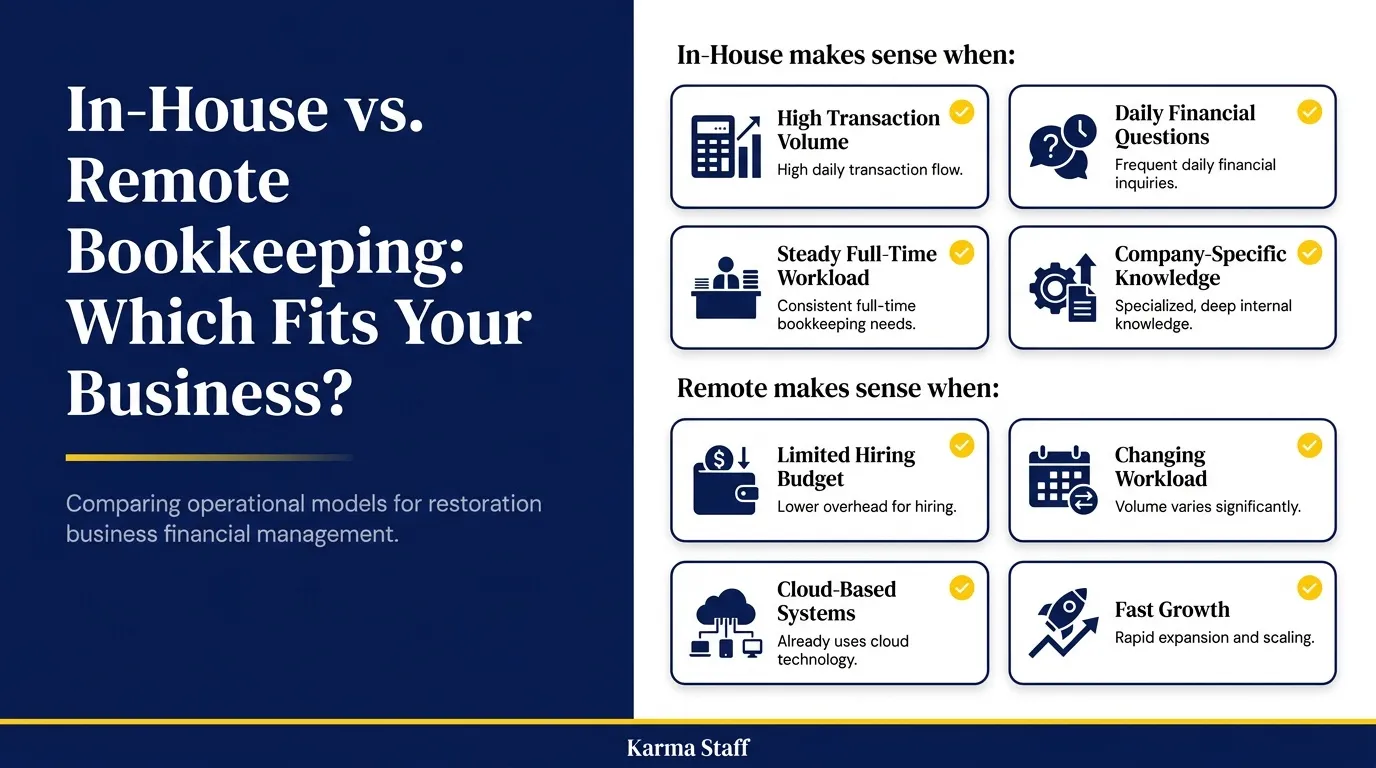
When In-House Bookkeeping Makes Sense
An internal employee may be the better choice when:
- The business has a high volume of daily transactions
- Financial questions arise throughout the day
- Several departments need regular support
- The workload is steady and full-time
- The business can manage fixed staffing costs
- Company-specific knowledge is especially important
This model works best when there is enough consistent work to justify the role.
When Remote Bookkeeping Makes Sense
Remote support may be a better fit when:
- The business has a limited hiring budget
- Workload changes throughout the year
- The company already uses cloud-based systems
- Specialized experience is needed
- The business is growing quickly
- Owners want fewer staffing responsibilities
It can also help businesses improve their financial process before they are ready to create a full internal department.
How to Choose the Right Option
Choosing between in-house vs remote bookkeeping should begin with your actual workload. Consider how many transactions you process, how complicated your reports are, how quickly the business is growing, and how often managers need financial information.
Then compare the complete cost, communication process, experience, security standards, and ability to scale.
A detailed bookkeeping comparison should also account for how your needs may change over time. A remote setup can work well during the early stages of a business, while an internal team may become more practical as the workload grows.
Some companies use both. An internal employee may manage daily tasks while a remote service supports payroll, reconciliations, monthly reporting, or busy periods.
The best option is the one that keeps your financial records accurate, current, and useful without creating unnecessary cost or complexity.
Conclusion
The choice between in-house vs remote bookkeeping depends on your transaction volume, budget, reporting requirements, internal systems, and growth plans.
In-house bookkeeping offers close involvement, direct communication, and detailed knowledge of the business. Remote bookkeeping provides flexibility, easier scaling, and access to broader experience without the full cost of hiring another employee.
Neither model is automatically better.
Review what your business needs today, but also consider where it may be six to twelve months from now. Your bookkeeping process should support growth, make financial information easier to understand, and give decision-makers a clearer view of the business.
FAQs
Q1. Is remote bookkeeping secure?
A: Yes, it can be secure when the provider uses reliable cloud systems, multi-factor authentication, restricted access, and clear data protection procedures. Businesses should always review a provider’s security practices before sharing financial information.
Q2. Can a business switch from in-house to remote bookkeeping?
A: Yes. Businesses can move between models as their needs change. The transition usually involves organizing existing records, transferring system access, reviewing account balances, and documenting the new workflow.
Q3. Do remote bookkeeping services replace accountants?
A: No. Bookkeeping services usually manage transactions, reconciliations, records, and regular reports. Accountants typically handle taxes, compliance, financial strategy, and more complex accounting decisions. The two often work together.
related news & insights.

Small business owners often manage sales, customer service, suppliers, and operations while trying to keep their finances current. Bookkeeping can become a task completed late at night, rushed before a tax deadline, or handled only when a bank balance raises concern. That approach leaves too
-
Introduction Remote bookkeeping depends on connected systems that let financial work happen accurately without a shared office. A bookkeeper needs more than an accounting platform. They also need reliable document capture, payment workflows, client communication, security controls, and reporting tools that work across locations. The