Restoration contractors operate in a financial environment that is anything but simple. Jobs are fast-moving, insurance payments can be delayed, and tracking costs across multiple projects requires precision. A single missed invoice or misclassified expense can distort your entire job profitability picture.
That’s why choosing the right bookkeeping setup is more than an administrative decision. It directly affects cash flow, job costing accuracy, and long-term growth. Whether you handle bookkeeping internally or outsource it, the structure you choose needs to match how your business actually runs.
For many owners evaluating bookkeeping for restoration contractors, the real question is not just cost. It is about control, speed, and the ability to scale without creating financial blind spots.
Why Bookkeeping Is Different for Restoration Contractors
Restoration work brings financial complexity that general bookkeeping systems often fail to handle properly. Unlike standard construction or service businesses, restoration contractors deal with insurance claims, emergency jobs, and fluctuating timelines.
Revenue is rarely straightforward. Payments may come in stages, depend on adjuster approvals, or arrive weeks after work is completed. Meanwhile, expenses hit immediately. Without tight bookkeeping, this mismatch can make your business look profitable on paper while cash is tight in reality
Job costing is another major factor. Each project involves labor, materials, subcontractors, and equipment usage that must be tracked accurately. If your bookkeeping system cannot tie these costs clearly to each job, you lose visibility into which projects are actually making money.
This is where the structure of your bookkeeping team starts to matter. The question becomes whether an in-house employee or a remote specialist is better equipped to handle these nuances.
What In-House Bookkeeping Looks Like
In-house bookkeeping means hiring an employee or team member who works directly within your company. They may sit in your office or work closely with operations, estimating, and project management teams.
This setup gives you immediate access to your financial data. If a project manager needs cost updates or an owner wants to review cash flow, the information is readily available without waiting for an external provider.
However, the effectiveness of in-house bookkeeping depends heavily on the skill level of the person you hire. Restoration accounting is specialized, and a general bookkeeper may struggle with insurance billing cycles, job costing, or revenue recognition.
It also requires ongoing management. You are responsible for training, oversight, and ensuring that processes are followed consistently. If your bookkeeper leaves, your financial system can quickly become disorganized.
Advantages Of In-House Bookkeeping
In-house bookkeeping offers a level of control and immediacy that many contractors value. It works best for businesses that want tight internal coordination.
– Real-time access to financial data and reports
– Direct communication with project managers and staff
– Faster handling of invoices, receipts, and job updates
– Greater control over processes and workflows
– Ability to customize systems to your exact operations
This setup is ideal if your business depends on constant financial visibility and quick decision-making.
Drawbacks Of In-House Bookkeeping
While control is a strong advantage, in-house bookkeeping also comes with operational challenges that are easy to underestimate.
– Higher fixed costs, including salary, benefits, and training
– Risk of limited expertise in restoration-specific accounting
– Dependency on one person for critical financial processes
– Time required for supervision and management
– Potential for inconsistency if processes are not documented
These challenges often become more noticeable as your workload increases.
What Remote Bookkeeping Looks Like
Remote bookkeeping involves outsourcing your financial management to a third-party provider. This can range from a freelance bookkeeper to a specialized firm that focuses on contractors or restoration businesses.
Instead of sitting inside your office, remote bookkeepers work through cloud-based systems. They access your financial data, update records, reconcile accounts, and provide reports without being physically present.
The key difference is specialization. Many remote providers are experienced in bookkeeping for restoration contractors, which means they already understand insurance workflows, job costing structures, and industry-specific reporting needs.
This setup reduces the need for internal management while giving you access to a broader skill set.
Advantages Of Remote Bookkeeping
Remote bookkeeping is built around efficiency and expertise. It allows contractors to focus on operations while financial management runs in the background.
– Access to experienced professionals with industry knowledge
– Lower overhead compared to full-time employees
– Scalable support as your business grows
– Consistent processes and standardized reporting
– Reduced risk of disruption if one team member leaves
This approach is often more adaptable for growing restoration companies.
Drawbacks Of Remote Bookkeeping
Despite its advantages, remote bookkeeping is not without trade-offs. The lack of physical presence can create certain gaps if not managed properly.
– Less immediate access to your bookkeeper during urgent situations
– Potential communication delays depending on provider structure
– Limited on-site involvement with your team
– Requires strong digital systems and documentation
– Less direct control over day-to-day processes
These limitations can be minimized with clear expectations and structured communication.
Cost Comparison: In-House Vs Remote
Cost is one of the most common deciding factors, but it should be evaluated beyond just salary or monthly fees.
An in-house bookkeeper typically comes with fixed costs. Salary, payroll taxes, benefits, and training can add up quickly. Even at a modest salary, the true cost is often significantly higher than expected.
Remote bookkeeping, on the other hand, is usually a variable cost. You pay for the level of service you need, which can scale up or down based on workload. This flexibility is especially useful for restoration contractors whose job volume fluctuates.
However, the cheapest option is not always the most effective. A low-cost provider who lacks industry knowledge can create costly errors in job costing or reporting.
The real comparison should focus on value. Accurate financial data, timely reporting, and reliable processes often outweigh the difference in monthly expenses.
Key Factors To Consider Before Choosing
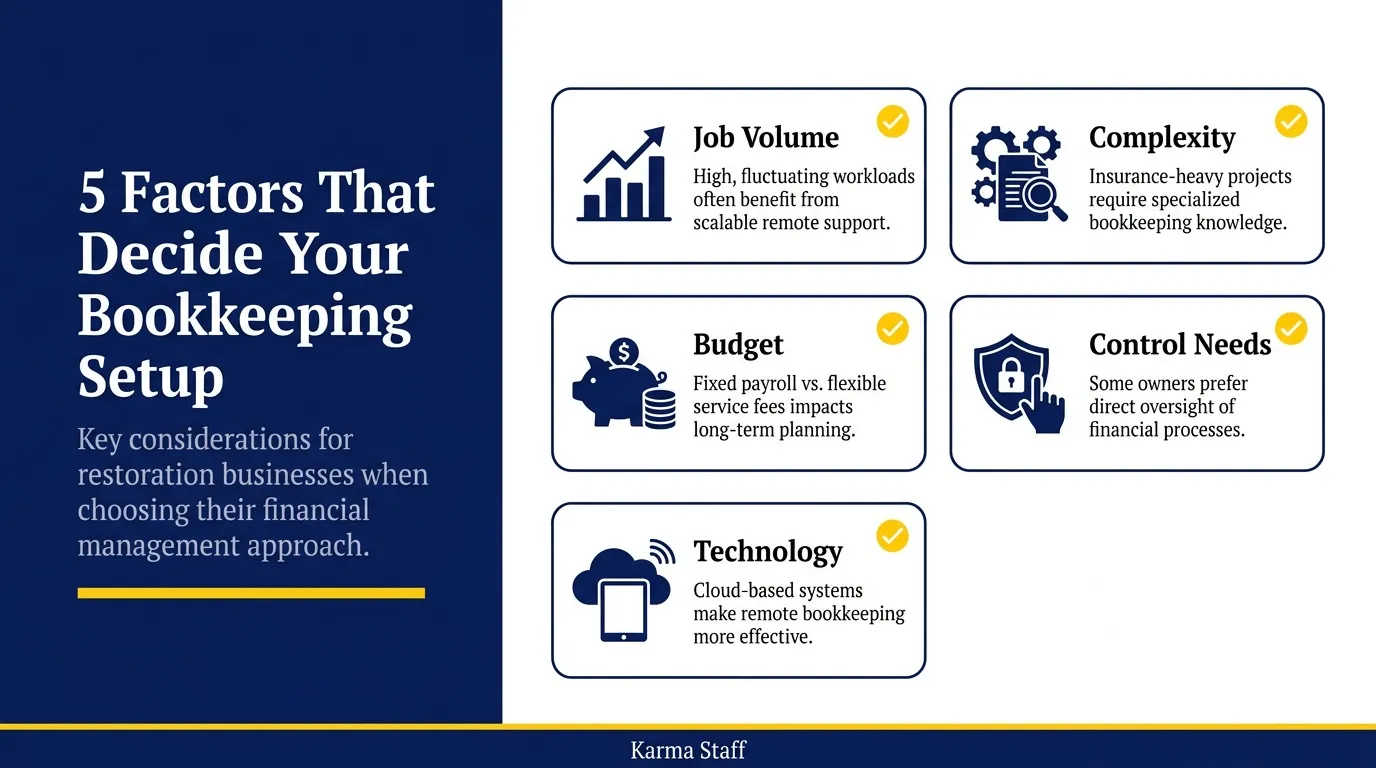
Choosing between in-house and remote bookkeeping depends on how your business operates, not just your budget. These factors will help clarify what fits best.
– Job volume: High and fluctuating workloads often benefit from scalable remote support
– Complexity: Insurance-heavy projects require specialized bookkeeping knowledge
– Budget: Fixed payroll vs flexible service fees impact long-term planning
– Control needs: Some owners prefer direct oversight of financial processes
– Technology: Cloud-based systems make remote bookkeeping more effective
These considerations will guide you toward a setup that aligns with your operational reality.
When In-House Bookkeeping Makes More Sense
There are situations where keeping bookkeeping internal is the better choice, especially for established contractors with structured operations.
– You have consistent job volume and stable processes
– Your team relies on constant in-person financial coordination
– You already employ experienced accounting staff
– You prefer full control over financial workflows
– Your systems are heavily customized to your business
In these cases, in-house bookkeeping can support tight integration across departments.
When Remote Bookkeeping Is The Better Option
Remote bookkeeping is often the smarter choice for contractors looking to improve efficiency without increasing overhead.
– Your business is growing rapidly and needs scalable support
– You lack in-house expertise in restoration accounting
– You want to reduce payroll and administrative burden
– Your financial systems are cloud-based or can be transitioned
– You need consistent reporting without managing staff
This approach allows you to focus on operations while maintaining strong financial oversight.
Hybrid Models: A Practical Middle Ground
Some restoration contractors find that a hybrid approach delivers the best results. This means combining in-house administrative support with remote financial expertise. For example, an office manager may handle daily data entry, receipts, and basic invoicing, while a remote bookkeeping firm manages reconciliations, reporting, and job costing analysis.
This structure balances control with expertise. It reduces costs compared to a full in-house team while maintaining faster access to day-to-day financial information.
Hybrid models are particularly effective for mid-sized contractors who are scaling but not ready to fully outsource or fully internalize their bookkeeping.
Conclusion
There is no universal answer to whether in-house or remote bookkeeping is better. The right choice depends on how your restoration business operates, how quickly it is growing, and how complex your financial processes have become.
For many contractors, the decision comes down to control versus flexibility. In-house teams offer immediate access and tighter integration, while remote providers bring specialized expertise and scalability.
Understanding the trade-offs in the in-house vs remote bookkeeping decision helps you avoid costly missteps and build a system that supports accurate job costing, steady cash flow, and long-term growth.
If your current bookkeeping setup is creating delays, confusion, or inconsistent reporting, it may be time to reassess and choose a structure that truly fits your business.
FAQs
Q: Is remote bookkeeping secure for financial data?
A: Yes, most remote bookkeeping providers use secure cloud-based systems with encryption and access controls. Security often depends more on the software used than the physical location of the bookkeeper.
Q: Can remote bookkeepers handle insurance-related restoration billing?
A: Many specialized providers are experienced in restoration workflows, including insurance claims, progress billing, and job costing tied to approvals and payouts.
Q: How do I transition from in-house to remote bookkeeping?
A: Start by organizing your financial data, choosing a cloud-based system, and working with a provider who can migrate your records while maintaining continuity in reporting and processes.
related news & insights.

Small business owners often manage sales, customer service, suppliers, and operations while trying to keep their finances current. Bookkeeping can become a task completed late at night, rushed before a tax deadline, or handled only when a bank balance raises concern. That approach leaves too
-
Introduction Remote bookkeeping depends on connected systems that let financial work happen accurately without a shared office. A bookkeeper needs more than an accounting platform. They also need reliable document capture, payment workflows, client communication, security controls, and reporting tools that work across locations. The