A capable bookkeeper can still struggle when receipts arrive late, approvals are unclear, and nobody can answer questions. But a good process cannot make up for missing bookkeeping skills either.
Before hiring, check how the person handles reconciliations, incomplete records, and job-related costs. Then give them clear responsibilities, suitable access, and someone who can resolve questions. This guide covers mistakes in both choosing a bookkeeper and getting the work started.
A Remote Bookkeeper Needs a Working System, Not Just Access
A remote bookkeeper is not simply an extra pair of hands inside accounting software. The role depends on receiving complete records, knowing who can answer operational questions, and understanding how the business wants exceptions handled.
That distinction matters because bookkeeping touches work that starts elsewhere. A technician may submit a receipt late. A manager may approve a vendor bill by text. A customer payment may arrive without a useful reference. If those details do not enter the process in a consistent way, the person doing the books has to pause, guess, or create a growing list of unresolved items.
Hiring remote bookkeepers works well when the business separates two responsibilities. The bookkeeper maintains the financial record. Someone inside the business decides what an unfamiliar charge, missing document, disputed invoice, or unusual payment means. Handing over the first responsibility does not remove the second.
The goal is not to create a perfect manual before anyone starts. It is to make the current process visible enough that a new person can follow it, question it, and improve it without reconstructing it from scattered messages.
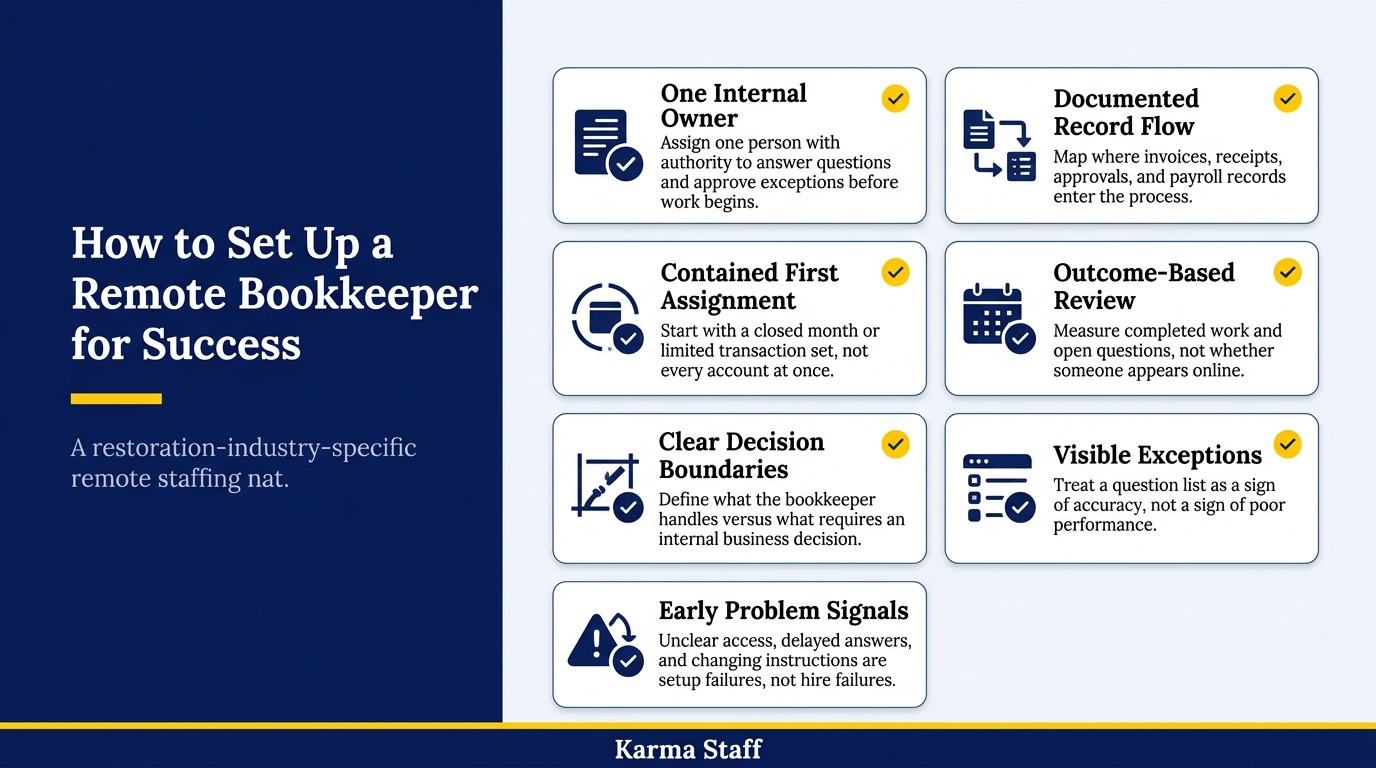
Assign One Contact for Questions and Approvals
Choose someone inside the business to coordinate answers and approvals. This could be the owner, office manager, or another person who understands the work and can reach the right people.
Their role is to explain business activity, collect missing records, and approve matters within their authority. Questions about accounting treatment or tax implications should go to the accountant when needed.
Agree on who will:
- Explain unfamiliar charges, deposits, and payment differences.
- Follow up on missing receipts and invoices.
- Approve bills, adjustments, and exceptions.
- Refer technical questions to the accountant.
- Review completed work on an agreed schedule.
The bookkeeper should not have to send the same question to several people and decide whose answer to follow.
Authority matters more than availability
A helpful contact who cannot approve anything is not enough. The remote bookkeeper needs to know whether a question requires an answer, a document, or a decision.
For example, a missing receipt may only need follow-up. A payment that does not match the invoice may require someone to decide whether the difference is a discount, a partial payment, or an error. Those are different problems, and they should not sit in the same unanswered queue.
Document How Records Reach the Bookkeeper
Walk through a few ordinary transactions before handing over the work.
For example, a supplier sends an invoice for materials used on a restoration job. Where is it submitted? Who confirms the purchase? How is the job identified? Who approves payment?
Document the same steps for customer payments, employee expenses, payroll records, and other recurring items.
Keep the instructions short enough to use. Include where records are stored, when they should arrive, and whom to contact when something is missing.
Give the bookkeeper an individual account wherever the system supports it, with access suited to their responsibilities. Confirm permissions for viewing records, changing entries, preparing payments, and approving payments separately.
When a process changes, update the shared instructions. A message buried in someone’s inbox should not become the only record of a new rule.
Test the Handoff With Closed Work First
The safest first assignment is work from a period the business has already completed. Closed work lets the new bookkeeper learn the records, the naming conventions, and the questions that come up without affecting a live payment cycle.
Choose a contained set of transactions rather than handing over every account immediately. A recent closed month, a limited group of vendor bills, or a set of reconciliations can show how the person handles missing information and follows written rules.
Review the test with specific questions:
- Did the bookkeeper find the records without repeated chasing?
- Did they identify items that needed a decision rather than guessing?
- Did the output match the established process where the process was clear?
- Did the review reveal steps that only existed in someone’s memory?
The point is not to demand that the first pass requires no corrections. Corrections reveal whether the issue is training, documentation, access, or judgment. A business that skips the test loses that information and may discover the same gaps during a busy week.
Do not confuse speed with readiness
A quick start can look productive while hiding a weak setup. If the new hire is moving through tasks without questions, confirm that the records were actually complete and that exceptions were not simply set aside.
Good bookkeeping work makes uncertainty visible. A question list can be a sign that the person is protecting the accuracy of the record rather than forcing incomplete information into a category.
Review Outcomes Instead of Watching Activity
A remote bookkeeping role needs a review rhythm focused on finished work and unresolved decisions. Constantly checking whether someone is online or sending messages usually creates noise without improving the books.
Agree on what a completed cycle looks like. That may include reconciled accounts, categorized transactions, an updated list of open questions, and records ready for the owner or accountant to review. The exact output depends on the business, but the definition should be clear before the work begins.
Keep review conversations practical. Ask what blocked completion, which records arrived late, and whether a recurring exception needs a written rule. If the same question appears several times, the process needs a decision or a clearer instruction.
The common mistake is treating management as surveillance. A remote bookkeeper needs accountable review, not minute-by-minute oversight. The business should be able to see what was completed, what remains uncertain, and who needs to act next.
What Goes Wrong Most Often
Knowing the software is useful, but it does not tell you how someone handles the books. Ask candidates to explain work they have completed, the problems they found, and how they resolved them.
For a restoration business, useful questions include:
- How would you investigate a customer payment that does not match an invoice?
- What would you do with a supplier bill that has no job reference?
- How do you investigate a difference during a bank reconciliation?
- What do you check before marking a month ready for review?
- When would you ask the owner or accountant for help?
Listen for a clear explanation of the checks they would make. Someone who immediately chooses a category without asking about missing information may need closer assessment.
Ask about experience with businesses that track costs by job. If they have not worked in restoration, find out what related experience they bring and what training they would need.
Where references are available, ask about accuracy, deadlines, communication, and follow-through.
The arrangement alone does not establish quality or ownership. Compare the actual responsibilities and support offered, rather than assuming an employee will handle everything or a freelancer will handle very little.
Final Verdict
If your records follow a repeatable path and one person can answer exceptions, hiring remote bookkeepers can remove recurring administrative work from the office. If invoices, receipts, approvals, and job costs still live across emails and conversations, organize that flow before expecting a new hire to repair it. The larger risk is not distance; it is assigning responsibility without defining authority.
The most common bookkeeping outsourcing mistakes come from vague ownership, incomplete records, and reviews that happen too late. Start with a contained handoff, judge the work against a completed period, and expand only after the questions have a clear route back to the business.
FAQs
Q: What should I prepare before hiring a remote bookkeeper?
A: Prepare a clear list of the work you want moved, the software involved, and the person who can answer financial questions. It also helps to map where invoices, receipts, approvals, and customer payments currently enter the business. The goal is to show how the work moves, not to create a long policy document.
Q: Should a remote bookkeeper be allowed to make financial decisions?
A: A bookkeeper can handle routine work within agreed rules and permissions. Define who approves payments, adjustments, and unusual transactions. Internal contacts can explain business activity, while technical accounting or tax questions may need the accountant.
Q: How do I know whether the bookkeeping handoff is working?
A: Look for completed work, a manageable list of open questions, and fewer repeated requests for the same information. A working handoff also makes missing records visible quickly. If the same questions return every week, review the process rather than assuming the bookkeeper needs more effort or supervision.
Q: Is it better to move all bookkeeping work at once?
A: A smaller starting scope makes the work easier to review. Use sample records or copies for the initial exercise, then introduce current tasks with appropriate access and checks. Avoid using live closed-period transactions for practice.
Q: What work should stay with the business owner or office manager?
A: Decisions that depend on operational context should remain with someone inside the business. That can include approving unusual expenses, explaining job-related costs, resolving customer payment differences, and deciding how exceptions should be handled. The remote bookkeeper can organize the information and identify what needs a decision.
related news & insights.

Accurate books give business owners a clear view of cash flow, margins, tax obligations, and available funds. A remote provider can reduce administrative work while giving you access to skilled bookkeeping support without hiring a full internal finance team. The right partner does more than
-
Small business owners often manage sales, customer service, suppliers, and operations while trying to keep their finances current. Bookkeeping can become a task completed late at night, rushed before a tax deadline, or handled only when a bank balance raises concern. That approach leaves too