A fire estimate becomes harder to review when damaged materials, cleaning tasks, and reconstruction are grouped into vague descriptions. The reviewer needs to understand what happened, which work is proposed, and how the quantities and prices were calculated.
A fire damage estimator builds that explanation from inspection records. Photos establish conditions, measurements support quantities, and notes explain decisions that would otherwise be unclear. Those records become the basis for selecting and pricing the work.
Build a Room-by-Room Record
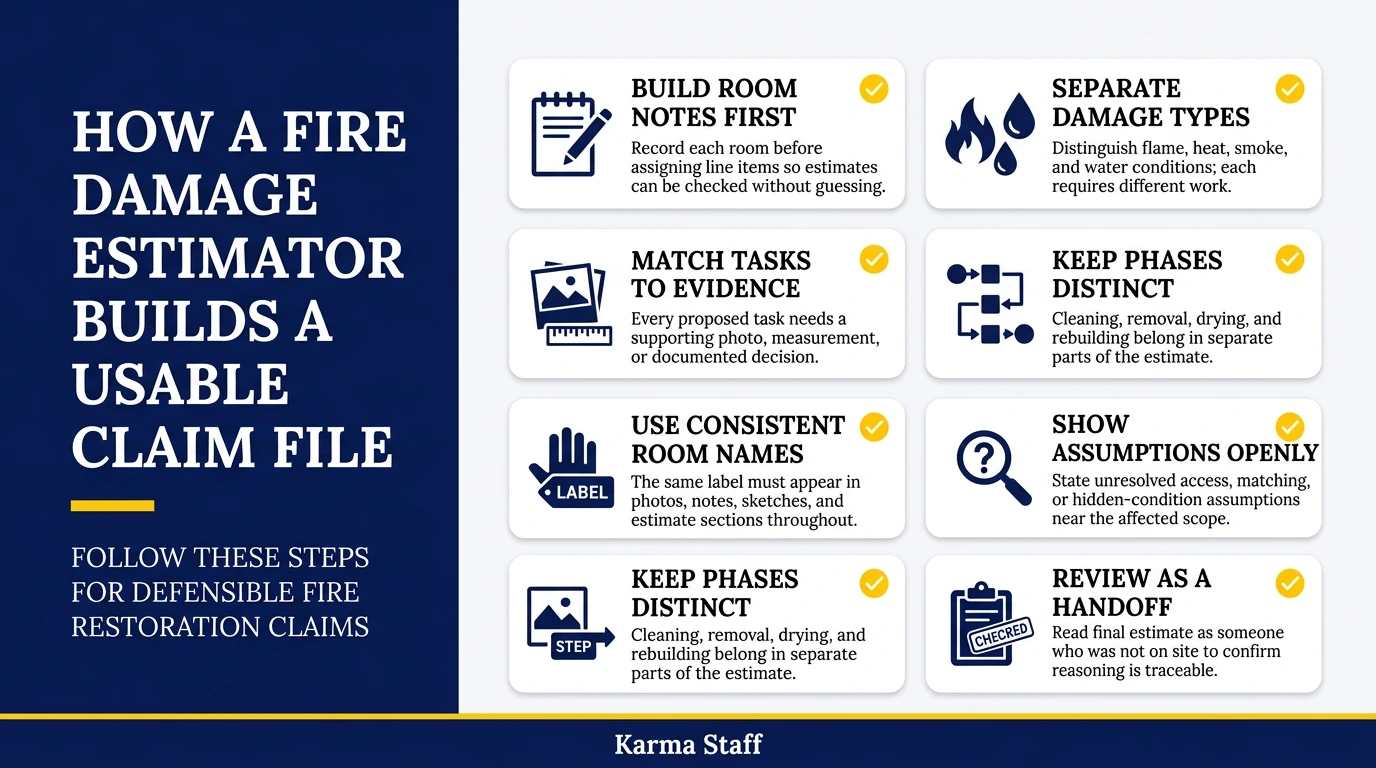
Start with consistent room names across the inspection notes, photo folders, sketches, and estimate. If the inspection calls a room “rear bedroom,” use that label throughout the file.
For each affected area, record:
- The material and surface involved.
- Visible damage or residue.
- Measurements and relevant openings.
- Supporting photographs.
- Access restrictions or concealed areas.
- Questions requiring further assessment.
Keep observations separate from proposed actions. “Dark residue on painted drywall” records a condition. “Remove and replace drywall” proposes work and needs an explanation.
If the site team cannot safely access an area, document that limitation. Do not fill the gap with an unsupported assumption.
Separate Damage Conditions From Repair Decisions
One room can contain several conditions: charred material near the fire, smoke residue elsewhere, and moisture from firefighting water. Record those conditions separately before deciding how each material should be handled.
The proposed work may involve cleaning, drying, removal, replacement, or further evaluation. Support the choice with the available inspection findings. When a decision requires a specialist’s assessment, identify that requirement rather than presenting it as settled.
Smoke damage estimating also needs clear boundaries. Explain which surfaces are included, where the affected area ends, and which adjacent spaces remain uncertain.
This gives the estimator a defined scope to price and makes later changes easier to trace.
Turn the Scope Into Measurable Tasks
Each estimate item should identify the task, location, quantity, unit, and supporting record.
Measure the work being proposed. A floor measurement does not automatically establish the quantity of wall cleaning. Likewise, a room photograph cannot substitute for dimensions when the item is priced by area.
Group tasks so the project team can distinguish emergency protection, contents handling, cleaning, removal, drying, and reconstruction. They can remain within one file while retaining clear descriptions and boundaries.
Check the selected item’s description before adding related work. Confirm what it includes so the estimate does not unintentionally charge for the same operation twice.
Unresolved work should be labeled clearly. State what remains unknown and what information is needed to price it.
How the Estimator Builds the Price
Once the task and quantity are established, the estimator selects a pricing basis appropriate to the job.
In estimating software such as Xactimate, that includes checking the applicable regional price list and its date. The selected item should also match the work: cleaning a surface, removing material, and installing a replacement are different operations.
Review the following:
- Unit: Is the item measured by square foot, linear foot, hour, or another unit?
- Quantity: Does it match the recorded dimensions and proposed treatment area?
- Rate: Is the pricing basis identified and appropriate to the location and work?
- Included components: What labor, materials, equipment, or related operations are already included?
- Project-specific costs: Does unusual work need a supplier quotation, subcontractor estimate, or another documented basis?
The basic calculation is quantity multiplied by unit rate. The completed estimate then needs review for any applicable additions, exclusions, or adjustments.
Where the selected pricing does not represent the proposed work adequately, explain the issue and retain supporting evidence. Avoid changing a rate without documenting the reason.Worked Example: From Inspection Note to Priced Item.
Review the Estimate Before Submission
Read the file from the perspective of someone who has never visited the property.
Check that:
- Room labels match across the records.
- Quantities can be traced to measurements.
- Proposed tasks have a documented basis.
- Rates and unusual costs have identifiable support.
- Related items do not duplicate work.
- Documented damage has not been omitted.
- Assumptions and pending decisions are visible.
Then confirm the handoff. Identify who will obtain missing information, update the estimate, and communicate revisions. Keep a record of what changed and why.
Final Verdict
Before assigning fire estimating work, agree on the room labels, photo organization, measurement requirements, and process for unresolved items.
A consistent inspection package gives the estimator a firmer basis for scoping and pricing. It also helps the project and office teams follow revisions without reconstructing the reasoning from scattered messages.
FAQs
Q: What should an estimator document first after a fire loss?
A: After access is authorized and safety restrictions are understood, record room conditions, affected materials, measurements, photographs, and inspection limitations.
Q: How does smoke damage estimating differ from estimating burned materials?
A: Smoke-related work may involve cleaning surfaces, treating contents, or investigating odor sources. Burned materials may require removal and reconstruction. Assess the condition and proposed treatment of each material rather than applying one approach throughout the room.
Q: Should cleaning and reconstruction appear in the same estimate?
A: Yes, provided their tasks and quantities remain distinguishable. The file should explain how work on existing materials relates to any proposed removal and replacement.
Q: What happens when concealed damage is found later?
A: Document the new condition, assess the additional work, and revise the affected scope and pricing. Keep the supporting records and explain how the revision differs from the earlier estimate.
related news & insights.

An estimator can be strong at pricing work and still be wrong for the job in front of them. The gap usually appears after a loss, when the office needs someone to turn incomplete field information into a claim-ready scope while conditions at the property

See how Tenzin Rapten helps restoration clients manage complex estimates, improve job tracking, and reduce unnecessary follow-ups through hands-on support.