There’s usually quite a bit happening behind the scenes of a restoration estimate.
Some files need revisions, others require additional documentation, and then there are carrier requirements, deadlines, and client requests to keep track of.
For Tenzin Rapten, figuring out what needs attention first is a regular part of the job, especially when several estimates and client requests arrive together.
He’s spent the past year and eight months working in the restoration industry with Karma Staff. He started as an Estimator and, after taking on more responsibilities, moved into his current role as Team Lead.
Today, his work includes reviewing estimates, helping other estimators, keeping the team’s work on track, and working directly with clients.
We caught up with him to learn more about his day-to-day work, his journey from Estimator to Team Lead, and a few experiences he’s picked up along the way.
Deciding What Needs Attention First
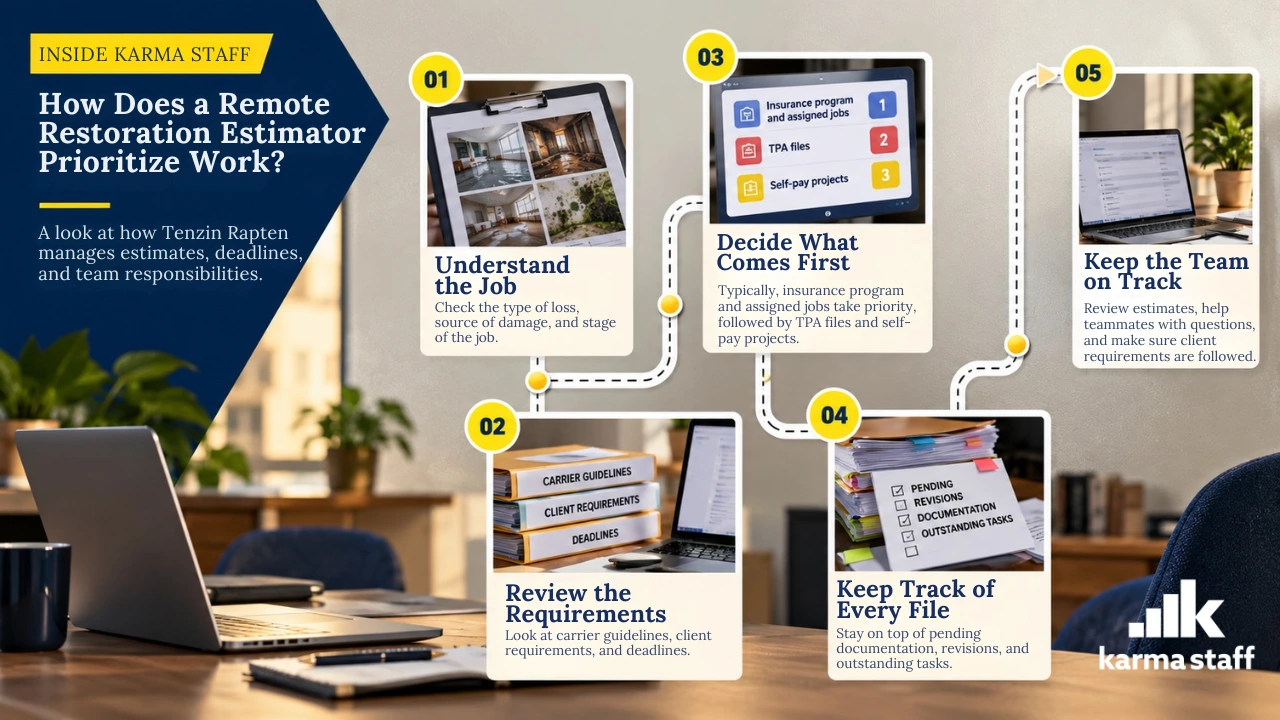
When several files come in together, Rapten starts by looking at what each one needs.
What kind of loss is it? Where did the damage come from? How far along is the job? Are there any carrier requirements or deadlines that could hold things up?
These details help him decide which assignments need attention first.
Insurance program and assigned jobs usually take priority, followed by TPA files and self-pay projects. He also tracks pending actions, documentation, and client requests to make sure files don’t get overlooked.
Of course, a plan can change when a revision comes back or someone needs help with a particular estimate.
That’s where his role as Team Lead comes in. Along with managing his own responsibilities, he reviews the team’s work, helps colleagues with questions, and makes sure client requirements are being followed.
Some Files Take Longer Than Others
Fire and contents estimates are among the more demanding assignments he’s worked on.
There’s the inventory itself, which can involve a long list of damaged belongings. Then comes determining what can be salvaged, what can’t, and whether the documentation supports those decisions.
Insurance carriers may also request additional information or revisions, which means going back through the file and making sure everything is accounted for.
For Rapten, the way through those jobs is to keep the information organized and stay in contact with adjusters and the people involved.
His experience also includes working with insurance program and TPA requirements, reviewing estimates, coordinating with adjusters, and applying his familiarity with IICRC S500 and S700 standards.
And even after nearly two years in restoration, he doesn’t consider himself finished learning.
“No one ever knows everything,” he told us.
It’s something he’s become more aware of since he started working with other estimators, each with their own ways of reviewing files, preparing documentation, and explaining scopes to adjusters.
How He Ended Up Leading a Team
Tenzin Rapten first came across Karma Staff on Instagram.
He was already interested in architecture, construction, and estimating, so the opportunity caught his attention.
He joined the company and began working with the PuroClean team under Phil, getting familiar with restoration estimates, insurance requirements, and the documentation that goes along with them.
For around a year and four months, estimating was his primary responsibility.
As he gained experience, he began taking on more responsibility and eventually moved into the Team Lead position.
These days, he spends part of his time reviewing other estimators’ work, helping new team members learn, and dealing with issues that come up during the workday.
He also gets to see how different people approach the same problem.
Sometimes a colleague has a better way of explaining a scope. Someone else might know a tool or documentation method he hasn’t used before.
He says working closely with the team has helped him learn more about the industry, even as he’s taken on the responsibility of guiding others.
A Two-Hour Conversation With Golden Touch Restoration
One of the examples Rapten shared had little to do with writing an estimate.
Golden Touch Restoration wasn’t using a CRM at the time. An Office Admin reached out to him to help explain how DASH CRM might fit into the company’s operations.
He ended up spending two hours with Taniesha Lewis, Golden Touch Restoration’s Office Manager.
They went through the platform, looking at how jobs could be tracked, what information the team could access, and how DASH could be adjusted to suit their workflow.
For a restoration office handling several active jobs, having a clearer picture of where everything stands can make day-to-day coordination easier.
That was one of the things he wanted to demonstrate during the session.
After the two-hour session, Golden Touch Restoration decided to move forward with DASH.
His experience with restoration workflows proved useful here, even though the conversation wasn’t about estimating.
He’s also helped introduce weekly open-job reports for clients, with updates on completed work, outstanding tasks, and the status of active jobs.
Clients can see where their jobs stand without having to check in on every file. Rapten says the reports have made communication easier and reduced unnecessary follow-ups.
His Workday Looks a Little Different Now
A lot has changed about Rapten’s workday since he first joined as an estimator.
He’s now helping other estimators learn, reviewing their work, managing floor operations, and sorting out technical issues when they come up. He’s also spending more time speaking with clients.
That includes joining sales meetings and working with Karma Staff’s CRO, Scott Sandel, on presentations for new clients as they get familiar with the team and its processes.
Through these conversations, he gets to understand how different restoration companies operate and where they could use an extra hand.
He wants to spend more time working directly with clients, understanding where their processes could improve, and finding practical ways to help.
That includes reducing delays in estimating and invoicing, improving how information moves between teams, and exploring how AI tools could help with estimate reviews.
He’s particularly interested in how technology can make the review process easier while still meeting carrier requirements, SLAs, and relevant industry standards.
The Part He Enjoys Most
When we asked Rapten what he’s most proud of, he brought up his journey from Estimator to Team Lead.
What he finds especially rewarding, though, is getting to train and mentor other team members.
He’s learned a lot about estimating, insurance requirements, and restoration processes since joining Karma Staff. Now he gets to pass that knowledge on and see his teammates grow in their own roles.
At the same time, working with other estimators has introduced him to different approaches to the work, from reviewing estimates to handling documentation and communicating with adjusters.
And he seems quite comfortable with the idea that there’s still plenty left to learn.
A Look at the People Doing the Work
Estimates are one part of running a restoration job. Keeping the documentation organized, handling revisions, and communicating with adjusters all take time too.
For Rapten, those responsibilities have gradually grown to include helping other estimators and supporting clients with their day-to-day operations.
From reviewing complicated estimates to helping a client figure out a new CRM, Rapten’s work has taken him into quite a few areas of restoration operations. And as he continues learning and helping his team grow, he’s putting that experience to use every day.
If estimating is taking up more time than you’d like, let’s talk about how Karma Staff can help.
related news & insights.

See how Golden Touch Restoration used full-time remote staffing to streamline office admin, claims, estimating, marketing, and business growth.

Finding a reliable estimator can make or break your project margins, especially in insurance restoration work where accuracy and speed matter. Contractors often hit a bottleneck when estimates pile up, deadlines tighten, or adjusters push back on numbers that lack proper documentation. That’s where Xactimate