
A property damage claim estimate is more than a list of repairs and prices. It sets the scope of work, identifies hidden damage, applies local labor costs, and can shape how much funding is available to restore the property correctly. A missed line item can leave an owner paying out of pocket later, while an unsupported or inflated scope can delay the claim.
A freelance Xactimate estimator can be useful when the loss involves detailed rebuilding work, disputed quantities, or a claim payment that does not match visible damage. The right choice depends on the size of the loss, the documents already available, and whether you can confidently identify every repair required to return the property to its pre-loss condition.
What A Xactimate Estimate Actually Does
Xactimate is estimating software widely used by insurers, contractors, public adjusters, and restoration professionals. It combines local pricing data with labor, materials, equipment, and construction tasks. The software itself does not determine what damage exists. The person preparing the estimate must inspect the property, measure accurately, understand repair methods, and select the correct line items.
A useful estimate connects each cost to a real condition at the property. For example, water damage to a kitchen may require more than replacing cabinet bases and drywall. The scope might also include detach and reset work, moisture-related demolition, insulation replacement, floor protection, paint blending, appliance handling, debris removal, and supervision. Whether each item belongs in the estimate depends on the facts, not on a generic template.
Xactimate also applies pricing by location. A roofing repair in one ZIP code may carry different labor and material costs than the same repair in another market. An experienced estimator knows that a price list date, tax setting, overhead and profit setting, and estimate profile can materially affect the final total.
The value of professional help is therefore not simply access to software. It is the ability to create a complete, supportable scope that can be reviewed by an insurer, contractor, or property owner without relying on assumptions.
The Decision Usually Turns On Claim Complexity
Small, visible, and straightforward repairs may not require outside estimating support. A single damaged interior door, a minor patch of drywall, or a limited flooring repair can often be documented with clear photos, measurements, and a contractor quote.
Complex claims are different because they involve interacting building components. A roof leak can lead to wet insulation, damaged ceiling finishes, electrical concerns, mold-related remediation, and code-related upgrades. Fire losses may involve cleaning, odor control, demolition, contents manipulation, and reconstruction across multiple rooms. Each trade can affect the scope and sequence of the next.
Claim value is another practical factor. If the gap between an insurer’s estimate and a contractor’s proposal is a few hundred dollars, paying for an independent estimate may not make financial sense. If the difference is several thousand dollars and the disagreement involves missing work rather than price preference, a detailed review can be worthwhile.
Timing matters as well. Estimates are strongest when prepared before repairs conceal conditions. Once wet materials are removed or damaged finishes are discarded, the claim may depend heavily on photographs, invoices, moisture records, and notes from the people who observed the loss.
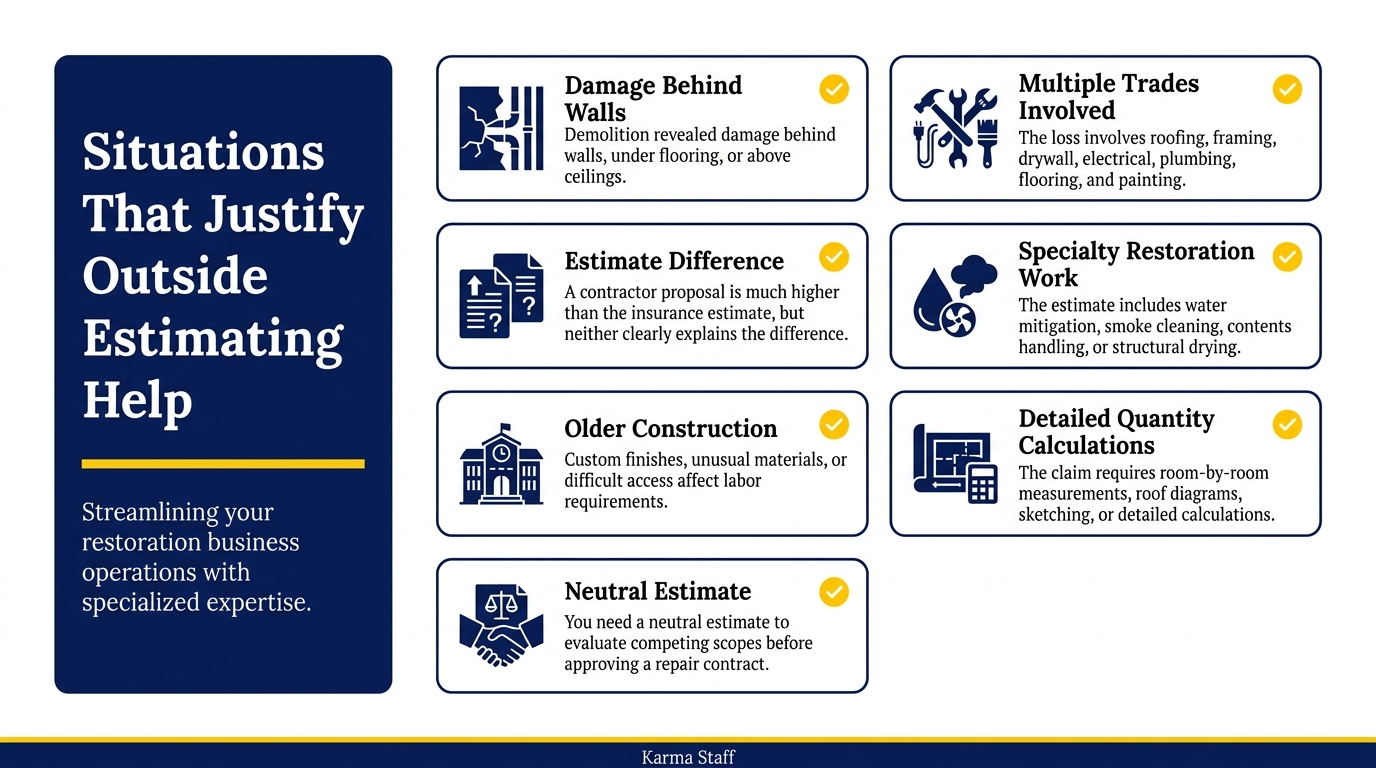
Situations That Justify Outside Estimating Help
Some claim conditions create enough uncertainty that a professionally prepared scope can save time and prevent costly omissions.
- The insurer’s estimate covers only visible finishes, but demolition revealed damage behind walls, under flooring, or above ceilings.
- The loss involves multiple trades, such as roofing, framing, drywall, electrical, plumbing, flooring, and painting.
- A contractor’s proposal is much higher than the insurance estimate, but neither document clearly explains the difference.
- The estimate includes specialty restoration work, including water mitigation, smoke cleaning, contents handling, or structural drying.
- The property has older construction, custom finishes, unusual materials, or difficult access that affects labor requirements.
- The claim requires room-by-room measurements, roof diagrams, sketching, or detailed quantity calculations.
- You need a neutral estimate to evaluate competing scopes before approving a repair contract.
These situations do not guarantee that an insurer will approve every added item, but they create a strong case for a documented, evidence-based estimate.
Where Self-Prepared Estimating Can Work
Preparing your own claim information can be reasonable if the damage is limited and you are focused on documenting facts rather than trying to recreate a full construction estimate.
- The damaged area is small, accessible, and easy to measure without specialized tools.
- The needed repair involves one trade and does not require demolition to identify the full extent of damage.
- You have dated photos, receipts, and a clear understanding of what was damaged by the reported event.
- A qualified contractor can provide a detailed written proposal that lists quantities, materials, and labor separately.
- The insurer’s scope generally matches the visible repairs, with only minor pricing or material differences.
A self-prepared file works best when it organizes evidence clearly and avoids unsupported assumptions about hidden work.
How An Independent Estimator Fits Into The Claim Process
An independent estimator is not a replacement for every professional involved in a claim. Their role is usually to inspect, document, measure, and prepare a repair scope using Xactimate or a comparable format. They may identify missing items, explain estimate differences, and help translate field conditions into clear construction language.
- Inspection documents affected rooms, materials, dimensions, access issues, and visible damage patterns.
- Photo labeling links each condition to a specific room, elevation, or repair item.
- Sketching calculates walls, ceilings, floors, roofing areas, openings, and other quantities.
- Scope development selects repair tasks that match the documented damage and proper work sequence.
- Estimate review compares the completed scope with the insurer’s estimate or contractor proposal line by line.
- Supporting documentation records the basis for additions, deletions, and quantity changes.
The final estimate should make it easier for all parties to discuss the actual work required rather than argue over a single total.
What To Provide Before Hiring An Estimator
A strong estimate begins with strong source material. Providing complete records before the inspection reduces guesswork and helps the estimator focus on unresolved scope issues.
- The insurer’s estimate, payment letter, adjuster correspondence, and claim number.
- Date-stamped photos and videos taken before cleanup, demolition, or temporary repairs.
- Contractor proposals, invoices, mitigation logs, drying records, and emergency service receipts.
- A list of rooms affected and a timeline showing when the damage was discovered and what work has occurred.
- Access details, property plans, prior repair records, and information about custom or discontinued materials.
- Specific questions about disputed work, such as missing insulation, cabinet detachments, roof accessories, or paint matching.
Organized documentation allows the estimator to build a scope around evidence rather than reconstruct the loss from memory.
Common Mistakes That Weaken A Claim Estimate
Most estimate problems begin before anyone opens Xactimate. Incomplete records, broad descriptions, and rushed repair decisions can make legitimate work harder to support later.
- Accepting a total without comparing the repair scope, quantities, and assumptions behind it.
- Using a contractor proposal that lists only a lump sum with no itemized work description.
- Repairing or removing damaged materials before taking clear, wide, and close-up photographs.
- Focusing only on material prices while overlooking labor, preparation, protection, and cleanup tasks.
- Assuming every item in a contractor bid is insurance-related without linking it to documented damage.
- Waiting until final repairs are underway to identify missing work or request a scope review.
A detailed file and an early scope review give you the best chance to resolve differences before construction decisions become harder to change.
Choosing The Right Level Of Help
Not every property owner needs a full independent estimate. Sometimes the best first move is a focused estimate review that compares the insurer’s scope against photographs and a contractor’s itemized proposal. This can identify whether the disagreement is caused by missing tasks, incorrect measurements, pricing differences, or work unrelated to the reported loss.
For larger or more technical losses, a site inspection and complete estimate may be the better option. Ask whether the estimator has experience with your loss type, understands local construction practices, and can explain each major scope decision in plain language. Request a sample redacted estimate if available, and confirm whether the service includes revisions after new evidence appears.
Before agreeing to a repair contract or accepting a final scope, request a professional review if the numbers do not reflect the work your property actually needs. The goal is not to make an estimate larger; it is to make it accurate, documented, and usable.
Conclusion
Estimating a property damage claim yourself can work for simple, visible repairs with clear documentation and a detailed contractor proposal. It becomes less reliable once the loss involves hidden conditions, several trades, specialized restoration work, or a meaningful gap between repair scopes.
If the claim is complex or the current estimate leaves unanswered questions, it may be time to hire Xactimate professional support. A qualified estimator can turn field evidence into a clear repair scope, helping you make better decisions before work begins.
FAQs
Q: Is an Xactimate Estimate Better Than a Contractor Estimate?
A: Neither estimate is automatically better. A contractor estimate shows how that contractor plans to perform the work, while an Xactimate estimate organizes costs into standardized line items and local pricing. Comparing both documents can reveal missing tasks, quantity differences, or different repair assumptions.
Q: Can A Freelance Xactimate Estimator Negotiate With My Insurance Company?
A: An estimator can prepare and explain a detailed scope, but negotiating insurance coverage may require a licensed public adjuster or another authorized representative, depending on local rules. Ask about the estimator’s permitted role before engaging them.
Q: When Should I Request an Estimate Review?
A: Request a review as soon as you notice that the insurer’s scope does not match documented damage, a contractor identifies omitted work, or demolition reveals additional conditions. Early review preserves evidence and gives all parties more time to address scope differences.
related news & insights.

Insurance restoration projects often stall before they even begin, not because of a lack of damage, but because the estimate fails to pass review. Contractors, adjusters, and property owners all feel the impact when an estimate is rejected or delayed. Payments get held up, timelines