Insurance restoration projects often stall before they even begin, not because of a lack of damage, but because the estimate fails to pass review. Contractors, adjusters, and property owners all feel the impact when an estimate is rejected or delayed. Payments get held up, timelines stretch, and trust erodes quickly.
A restoration claim estimator plays a central role in this process. Their ability to document, justify, and present costs clearly can determine whether a claim moves forward smoothly or gets pushed back for revisions. Understanding why estimates are rejected is the first step toward preventing it and protecting both your workflow and revenue.
The Real Role Of An Estimate In Restoration Claims
An estimate is more than a price sheet. It is a structured argument that explains what happened, what needs to be done, and why the cost is justified. Insurance carriers are not just checking numbers; they are evaluating logic, scope alignment, and documentation quality.
A strong estimate connects three key elements: cause of loss, extent of damage, and necessary repairs. If any of these are unclear or unsupported, the entire claim becomes questionable. This is why even experienced contractors can face rejections if their estimates lack clarity or consistency.
Most Common Reasons Estimates Get Rejected
Even detailed estimates can fail if they miss specific expectations from insurers. These issues tend to repeat across projects, regardless of size or location.
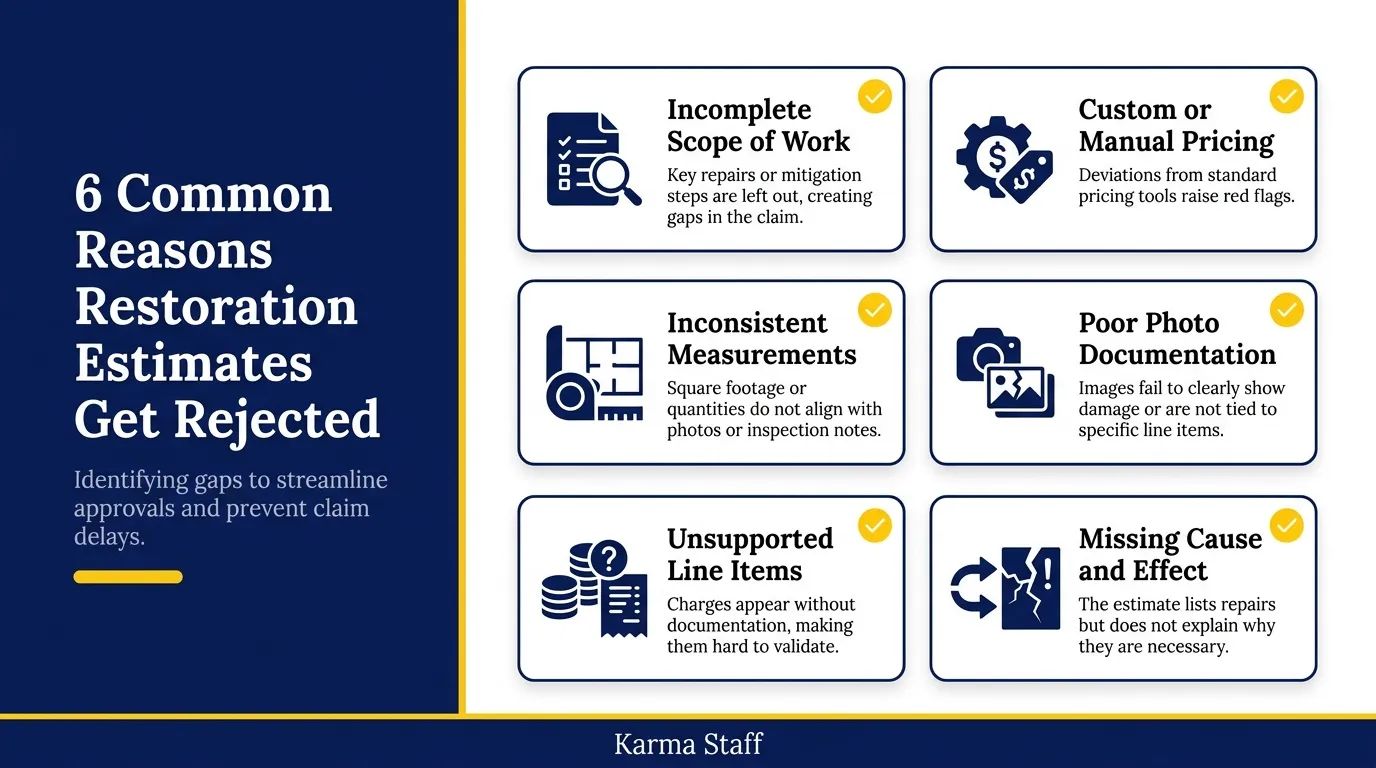
– Missing or incomplete scope of work: Key repairs or mitigation steps are left out, creating gaps in the claim.
– Inconsistent measurements: Square footage or quantities do not align with photos or inspection notes.
– Unsupported line items: Charges appear without documentation, making them hard to validate.
– Overuse of custom or manual pricing: Deviations from standard pricing tools raise red flags.
– Poor photo documentation: Images fail to clearly show damage or are not tied to specific line items.
– Lack of cause-and-effect explanation: The estimate lists repairs but does not explain why they are necessary.
These issues signal risk to insurers, which often leads to requests for revision or outright rejection.
Documentation Gaps That Trigger Immediate Pushback
Even a well-priced estimate can be rejected if the supporting documentation is weak or disorganized. Insurance reviewers rely heavily on evidence to validate claims.
– No clear before-and-after context: Photos do not establish the condition prior to damage.
– Missing moisture or environmental readings: No data to justify drying or remediation work.
– Incomplete diagrams or sketches: Layouts do not match the written scope.
– Disconnected notes and images: Photos are not labeled or tied to specific damage areas.
– Lack of timestamps: Documentation does not show when inspections or work occurred.
Strong documentation reduces back-and-forth and builds credibility with adjusters.
Pricing Discrepancies And Why They Matter
Pricing is one of the fastest ways an estimate gets flagged. Insurance carriers rely on standardized pricing databases to maintain consistency across claims. When a restoration claim estimator uses rates that fall outside accepted ranges, the estimate invites scrutiny. This does not mean higher pricing is always wrong; it means it must be justified.
For example, emergency service rates, specialized equipment, or regional labor shortages can justify higher costs. However, without clear explanation or supporting data, those numbers look arbitrary. Insurers are trained to challenge anything that appears inconsistent with benchmarks.
The key is alignment. If pricing differs, the estimate must explain why in a way that is easy to verify.
How Scope Creep Leads To Rejections
Scope creep occurs when additional work is included without clear justification tied to the original loss. While some expansion is valid, it must be documented properly.
Insurance carriers evaluate whether each repair is directly related to the covered event. If the estimate includes unrelated upgrades or pre-existing issues, it risks rejection.
For instance, replacing undamaged materials or upgrading finishes beyond the original condition can trigger pushback. The estimate must distinguish between necessary restoration and optional improvements.
Clear separation between these elements helps prevent confusion and keeps the claim focused.
Mistakes Restoration Professionals Often Overlook
Small oversights can undermine an otherwise solid estimate. These are not always obvious, but they can significantly affect approval rates.
– Forgetting line item descriptions: Vague entries make it hard for adjusters to understand the work.
– Skipping depreciation considerations: Estimates ignore how age or condition affects value.
– Using inconsistent terminology: Different terms for the same item create confusion.
– Not updating estimates after revisions: Old data remains in the file, causing contradictions.
– Ignoring insurer-specific guidelines: Each carrier may have unique expectations or formats.
Avoiding these mistakes improves both clarity and credibility.
How A Restoration Claim Estimator Improves Approval Rates
A skilled restoration claim estimator does more than calculate costs; they translate field conditions into a format insurers trust. This requires both technical knowledge and communication skills.
They understand how to structure estimates so that each line item connects logically to documented damage. They also know how to use industry-standard tools effectively, reducing the likelihood of pricing disputes.
More importantly, they anticipate objections before they happen. By addressing potential concerns within the estimate, they reduce the need for revisions and accelerate approvals.
This proactive approach often separates smooth claims from prolonged disputes.
Steps To Create An Estimate That Gets Approved Faster
Improving approval rates requires a repeatable process. These steps help ensure consistency and reduce avoidable errors.
– Start with a thorough inspection: Document all damage before writing any part of the estimate.
– Use standardized pricing tools: Align with commonly accepted databases to reduce disputes.
– Match scope to documented damage: Every repair should have clear visual or written support.
– Include detailed notes for complex items: Explain anything that might raise questions.
– Organize photos logically: Group images by area and link them to specific line items.
– Review for internal consistency: Ensure measurements, notes, and pricing all align.
Following these steps creates a cleaner, more defensible estimate.
Communication Breakdowns Between Contractors And Adjusters
Many rejected estimates are not about accuracy—they are about miscommunication. Contractors and adjusters often interpret the same information differently.
Contractors focus on what is required to restore the property properly. Adjusters focus on what is covered under the policy. When these perspectives are not aligned, friction occurs.
Clear communication helps bridge this gap. This includes writing estimates in a way that is easy to review, responding quickly to questions, and providing additional documentation when needed.
A collaborative approach often leads to faster resolutions and fewer rejections.
Technology And Tools That Reduce Rejection Risk
Modern estimating tools have made it easier to standardize and validate restoration claims. However, they must be used correctly to be effective.
– Estimating software with pricing databases
Keeps costs aligned with industry standards.
– Photo documentation apps
Automatically tag and organize images.
– Moisture mapping tools
Provide data-backed justification for drying work.
– Cloud-based project management systems
Allow easy sharing of files with adjusters.
– Audit and review features
Help catch inconsistencies before submission.
Using the right tools improves both accuracy and efficiency.
Conclusion
Rejected estimates are rarely random. They usually result from gaps in documentation, unclear scope, or pricing inconsistencies that raise concerns during review. Addressing these issues requires a structured approach, not guesswork.
Insurance restoration estimates that are clear, well-supported, and aligned with industry standards move through the approval process faster. A skilled estimator who understands both fieldwork and insurer expectations can make a measurable difference in outcomes.
If you want fewer revisions and quicker approvals, invest in better estimating practices or bring in a dedicated expert who can handle the process with precision.
FAQs
Q: How can I reduce the chances of my estimate being rejected?
A: Focus on clear documentation, consistent pricing, and a well-defined scope that directly ties to the damage.
Q: Do insurance companies always require standardized pricing tools?
A: Most insurers prefer estimates aligned with accepted pricing databases, though exceptions can be justified with proper documentation.
Q: What makes insurance restoration estimates more credible?
A: Strong photo evidence, detailed notes, logical structure, and alignment between scope, pricing, and documented damage all increase credibility.
related news & insights.

Introduction Water, fire, mold, or storm damage can turn a manageable repair into a long disruption when work begins without a clear plan. Fast action matters, but speed without coordination often creates avoidable delays later. A detailed plan gives every trade, supplier, insurer, and property
-
A project budget can look realistic on paper and still fail once work begins. Missing quantities, outdated material prices, unclear scopes, and unplanned site conditions often create expenses that were not included in the original figure. An estimator helps turn incomplete project information into a